











I have been involved with MLM and Network Marketing since the mid Seventies and If you’ve been around the network marketing industry for more than a few years, you’ve probably noticed something interesting. I know I have and I like the new direction.
The way successful MLM companies operate today is very different from how they operated decades ago.
While there are still companies following the traditional model, a new generation of businesses has emerged—one that embraces technology, affordability, and modern consumer expectations.
Let’s take a look at how the industry has evolved.
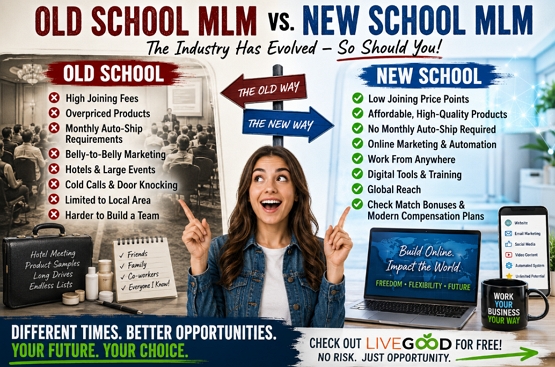
The Old School MLM Model
Years ago, joining a network marketing company often required a significant financial commitment.
Large enrollment packages were common, sometimes costing hundreds or even thousands of dollars before you could even begin building your business.
On top of that, many companies encouraged distributors to purchase large amounts of inventory, often with monthly auto-ship requirements that could become expensive over time.
The marketing approach was also very different.
Success usually meant:
- Hosting hotel meetings
- Inviting friends and family to home presentations
- Carrying product samples everywhere
- Making cold calls
- Building lists from everyone you knew
- Traveling from event to event
Many people built incredible businesses this way, but it wasn’t for everyone.
Some loved the face-to-face interaction.
Others found it intimidating.
The Rise of the Internet
As the internet matured, marketers began discovering entirely new ways to build relationships.
Instead of knocking on doors, they started creating websites.
Instead of making cold calls, they published articles.
Instead of only speaking to local prospects, they reached people around the world.
Social media, video marketing, email marketing, webinars, blogging, and online communities completely changed what was possible.
Network marketing was no longer limited by geography.
The New School MLM Model
Today’s successful companies are increasingly removing many of the barriers that discouraged people in the past.
Modern compensation plans often include:
- Lower startup costs
- Affordable products
- Little or no inventory requirements
- No mandatory monthly product purchases in some programs
- Online enrollment
- Digital marketing tools
- Automated follow-up systems
- Mobile-friendly businesses
- Team support through Zoom and online communities
Many also reward leadership in new ways, including matching bonuses or check-match style commissions that allow leaders to earn additional income by helping their teams succeed.
The emphasis has shifted from simply recruiting people to building systems that help ordinary people duplicate success more efficiently.
Technology Has Changed Everything
Today’s network marketer has tools previous generations could only dream about.
Artificial intelligence can help create content.
Social media can introduce your business to thousands of people.
Video allows you to demonstrate products without leaving your home.
Email automation follows up with prospects while you sleep.
Training is available on demand instead of waiting for the next monthly meeting.
The opportunity has become more flexible than ever before.
A Company That Helped Change Expectations
One company that significantly influenced this shift is LiveGood.
Rather than following many of the traditional network marketing practices, LiveGood introduced a model that emphasized affordability and accessibility.
Instead of requiring a large investment to get started, it offers a very low-cost membership.
Instead of relying on expensive monthly product requirements, members could choose whether or not to purchase products while still maintaining their membership.
The company also focused on offering competitively priced health and wellness products, making them accessible to more consumers.
Its compensation plan introduced features such as a matrix structure and matching bonuses that rewarded team building while keeping entry costs low.
Whether someone joins simply to save money on products or decides to build the business, the lower financial barrier has attracted people who may have never considered network marketing before.
Since LiveGood launched, many people have noticed other companies beginning to adopt similar ideas—lower startup costs, simplified compensation plans, stronger online marketing support, and reduced purchasing requirements. While each company has its own unique approach, the industry as a whole has clearly been moving toward a more modern, internet-friendly business model.
Is the New School Better?
Not necessarily.
The old-school approach built countless successful businesses and created many industry legends.
But today’s technology gives people more options.
Some marketers still enjoy hotel meetings and in-person presentations.
Others prefer building relationships through articles, videos, email, and social media.
The good news is that today’s entrepreneur can often choose the methods that best fit their personality and lifestyle.
Final Thoughts
Network marketing continues to evolve, just as every industry does.
Companies that embrace affordability, flexibility, technology, and simplicity are attracting a new generation of entrepreneurs who want to build businesses without many of the traditional barriers of the past.
If you’ve been curious about what this new school approach looks like, LiveGood is worth exploring.
You can create a free account, take a look around, review the products and compensation plan, and decide for yourself whether it’s a good fit for your goals.
 Click here to create your FREE LiveGood account and see why so many people are taking a fresh look at network marketing.



Leave a Reply
You must be logged in to post a comment.